
The early life of Pablo Picasso began in Málaga, Spain, where he was born to an art teacher father who nurtured his talent. From a very tender age, he demonstrated an astonishing capacity for drawing and realistic representation that quickly surpassed conventional academic standards. His formal training started under strict familial guidance, eventually leading him through prestigious institutions where he rapidly absorbed classical techniques. However, his restless creative spirit refused to stay confined within traditional boundaries, pushing him to explore new horizons. This foundational period laid the groundwork for a revolutionary artistic journey that would completely redefine global creative standards and aesthetics for generations.
| Attribute | Detail |
| Full Name | Pablo Diego José Francisco de Paula Juan Nepomuceno María de los Remedios Cipriano de la Santísima Trinidad Ruiz y Picasso |
| Birth Date | October 25, 1881 |
| Birth Place | Málaga, Spain |
| Death Date | April 8, 1973 |
| Profession | Painter, Sculptor, Printmaker |
| Notable Movement | Cubism |
Growing up in a household deeply immersed in visual education, Pablo Picasso received intense early instruction that shaped his technical proficiency. His father recognized exceptional aptitude early on, providing rigorous drills in figure drawing and oil painting. These formative years spent moving across different Spanish cities exposed him to diverse cultural landscapes that stimulated his young imagination. He absorbed local scenery and translated it onto canvas with remarkable maturity. This exceptional background ensured that Pablo Picasso developed an advanced understanding of composition long before reaching adulthood, setting the stage for his dramatic departure from academic constraints later in life.

Relocating to Barcelona marked a major turning point as Pablo Picasso entered the local fine arts academy and interacted with avant-garde circles. Although his family anticipated a traditional career of academic success, the young visionary grew deeply frustrated with rigid institutional rules. He frequented local cafes, meeting progressive writers and fellow painters who challenged conventional ideologies. This stimulating environment encouraged him to question established artistic norms and seek innovative pathways of personal expression. Consequently, Pablo Picasso chose to break away from safe academic formulas, embarking on a daring path toward total creative independence and stylistic experimentation.
Transitioning into the twentieth century, Pablo Picasso entered a deeply reflective phase known as his Blue Period. Triggered by poverty and personal tragedy, his palette shifted exclusively to monochromatic shades of blue and blue-green, evoking powerful feelings of isolation. During these difficult years, he painted destitute outcasts, beggars, and melancholy figures with haunting grace. The emotional weight captured in these canvases demonstrated a profound empathy for human suffering. Through this somber yet captivating body of work, Pablo Picasso established his ability to channel raw psychological intensity directly onto the surface of his paintings.

Following years of melancholy, Pablo Picasso experienced a vibrant stylistic evolution characterized by warmer tones and lighter emotional themes. This Rose Period introduced cheerful pinks, reds, and earthy ochres, reflecting a happier lifestyle after settling in Paris. His subjects shifted toward circus performers, acrobats, and harlequins, capturing both their public grace and private vulnerability. This joyful transition highlighted his versatility and willingness to reinvent his aesthetic language continuously. Ultimately, Pablo Picasso proved that his creative vision could pivot fluidly from profound sorrow to whimsical charm without losing any structural integrity.
Working alongside fellow visionary Georges Braque, Pablo Picasso fundamentally dismantled traditional perspective by inventing the revolutionary movement of Cubism. They abandoned single-point viewpoint in favor of fragmented planes, geometric grids, and simultaneous multiple angles. This radical approach forced viewers to reconstruct objects mentally rather than accepting passive visual representation. The sheer audacity of this breakthrough permanently altered the trajectory of modern Western art. By reducing complex forms to intersecting cubes and planes, Pablo Picasso forever changed how humanity perceives visual space and physical reality on canvas.

As his experiments with geometric abstraction deepened, Pablo Picasso expanded his technical repertoire by inventing the artistic technique of collage. He began gluing oilcloth, newspaper clippings, and cardboard directly onto his canvases, blurring the line between high art and everyday materials. This phase, known as Synthetic Cubism, introduced flat decorative patterns and simplified shapes that emphasized the physical surface of the work. Such bold innovations challenged traditional definitions of painting and sculpture. Through these clever assemblages, Pablo Picasso demonstrated that ordinary mundane objects could possess profound aesthetic and conceptual power.
During the turbulent era of the First World War, Pablo Picasso underwent a surprising stylistic shift toward monumental classical forms and Neoclassicism. Inspired by trips to Italy and ancient sculptures, he began rendering robust, sculptural human figures with heavy, statuesque proportions. This return to order surprised many critics who expected him to continue pushing pure abstraction. Yet, this neoclassical direction reflected his deep respect for historical tradition and timeless human anatomy. Pablo Picasso effortlessly bridged ancient sculptural ideals with modern sensibilities, proving his mastery over both radical disruption and traditional execution.
Interacting closely with avant-garde writers and theorists during the nineteen-twenties, Pablo Picasso incorporated dreamlike distortions and psychological symbolism into his creative practice. His figures became fluid, contorted, and surreal, reflecting the subconscious mind and intense personal anxieties. This phase captured a turbulent emotional landscape characterized by erratic shapes, violent color contrasts, and surreal metaphors. Such striking imagery resonated deeply with the broader European surrealist movement. By embracing these bizarre, dream-inspired distortions, Pablo Picasso unlocked new dimensions of emotional honesty and visceral impact in his visual storytelling.
Responding directly to the brutal bombing of a Basque town during the Spanish Civil War, Pablo Picasso created his most iconic masterpiece, Guernica. This monumental mural-sized canvas utilized stark black, white, and gray tones to depict the horrific suffering of innocent civilians and animals. Through agonizing, fragmented imagery of weeping women and gored horses, it became an enduring universal symbol against the atrocities of war. The emotional resonance of the piece shook international audiences. With this powerful anti-war statement, Pablo Picasso solidified his role not just as a stylist, but as a conscience for humanity.
Throughout his long and prolific career, Pablo Picasso consistently pushed the boundaries of sculpture by assembling found objects into witty figures. He welded bicycle parts, metal scraps, and discarded utensils into whimsical animal forms and expressive human heads. This innovative approach to assemblage redefined three-dimensional creation, inspiring generations of modern sculptors. He treated physical space with the same playful experimentation that defined his paintings. By transforming junk into high art, Pablo Picasso demonstrated an unmatched ability to breathe life into discarded materials through pure creative genius.
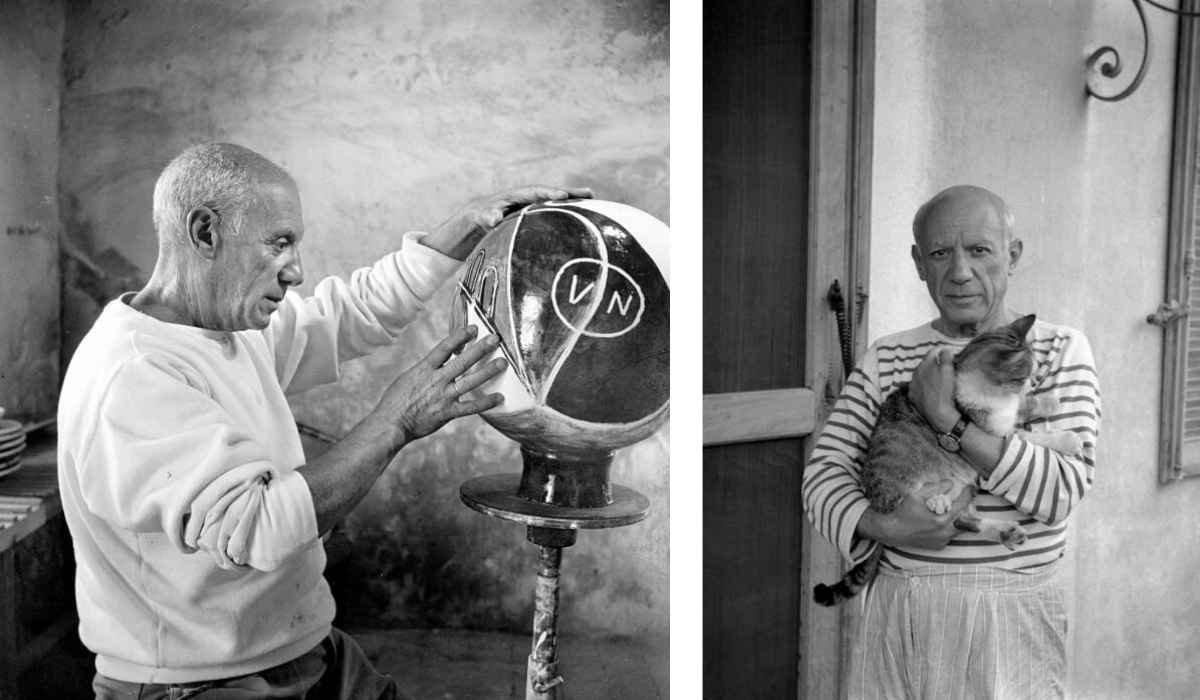
Later in life, Pablo Picasso discovered a profound passion for ceramic arts while visiting the Madoura pottery workshop in the south of France. He began turning ordinary plates, pitchers, and vases into whimsical owls, bulls, and human faces using colorful glazes. This hands-on engagement with clay brought immense joy and renewed energy to his daily routine. He embraced the natural curves of pottery vessels, integrating them seamlessly into his painted designs. Through these charming ceramic creations, Pablo Picasso proved that fine art could thrive equally on functional everyday objects made for common use.
Beyond painting and sculpture, Pablo Picasso produced an extraordinary volume of printmaking, including etchings, lithographs, and linocuts. He experimented restlessly with print techniques, often collaborating with master printers to push technical limitations. His graphic works explored recurring mythological themes, bullfighting scenes, and intimate domestic portraits with astonishing line precision. This prolific output made high-quality fine art more accessible to wider collectors and museums worldwide. The sheer technical brilliance found in his prints highlights the relentless work ethic that defined Pablo Picasso until his final years.
The intricate personal life of Pablo Picasso heavily influenced the emotional evolution and thematic shifts visible across his extensive oeuvre. He shared his life with numerous wives, partners, and muses who frequently served as the primary focus of his portraits. Each relationship brought a distinct emotional climate, altering his color palette and stylistic treatment from tender adoration to fierce critique. While his passionate romances fueled immense creative output, they often involved intense personal drama. Understanding these complex partnerships provides crucial context for interpreting the psychological layers embedded within the art of Pablo Picasso.
Deeply rooted in Mediterranean heritage, Pablo Picasso maintained a lifelong obsession with classical mythology, frequently featuring minotaurs, fauns, and centaurs in his work. These mythical creatures served as alter egos representing his primal instincts, artistic passions, and complex masculinity. He portrayed the minotaur shifting between gentle protector and tormented monster across numerous etchings and drawings. This recurring motif connected his contemporary personal struggles to ancient epic traditions. By invoking these legendary beasts, Pablo Picasso created a personal mythology that mirrored his own larger-than-life artistic persona and mortal vulnerabilities.
Holding a legendary reputation for relentless productivity, Pablo Picasso created tens of thousands of paintings, drawings, prints, sculptures, and ceramics. His daily routine revolved around continuous creation, driven by an insatiable urge to experiment with new techniques right up to old age. He viewed art-making as a vital necessity rather than a passive career choice, working across multiple mediums simultaneously. This staggering volume of work ensures his presence remains inescapable in global cultural institutions. The sheer industrial scale of output achieved by Pablo Picasso stands as a monumental testament to human dedication.
During his final decades, Pablo Picasso dedicated considerable energy to reimagining famous masterworks created by historical giants like Velázquez, Delacroix, and Manet. He dissected their classic compositions, painting dozens of playful, highly distorted variations that challenged traditional reverence. This dialogue with art history allowed him to test his own skills against historical masterpieces with witty irreverence. Rather than copying, he deconstructed and rebuilt their narratives through his distinct modern lens. These late reinterpretations demonstrated that Pablo Picasso remained an active student of art history until the very end of his life.
Regarded globally as one of the most famous figures in cultural history, Pablo Picasso achieved unprecedented fame and financial success during his lifetime. His exhibitions drew massive crowds, and his auction records shattered financial milestones repeatedly across international art markets. Museums dedicated entirely to his work opened in major cities like Barcelona and Paris, preserving his vast contributions for posterity. This extraordinary commercial and institutional triumph cemented his status as a titan of civilization. Even today, the cultural footprint left by Pablo Picasso commands universal respect and endless academic study.
Following a remarkable life spanning over nine decades, Pablo Picasso passed away on April 8, 1973, in Mougins, France, leaving behind an unmatched creative legacy. He was laid to rest at the Château of Vauvenargues, a historic property he had owned and utilized as a studio workspace during his later years. His funeral and subsequent tributes drew global mourning from artists, critics, and admirers worldwide. Though his physical body departed, his monumental influence continued to reverberate across every corner of international culture. The death of Pablo Picasso marked the close of an era, yet his spirit lives on through his timeless creations.
The enduring impact of Pablo Picasso continues to shape contemporary visual culture, inspiring successive generations of painters, sculptors, and conceptual designers. His fearless willingness to break rules and reinvent styles taught creators that artistic boundaries are meant to be challenged. Art schools worldwide routinely study his methodology as a cornerstone of modern aesthetic education. His ability to fuse technical mastery with emotional raw power remains an eternal benchmark for excellence. To explore his full historical impact further, one can review comprehensive resources such as the Pablo Picasso profile.